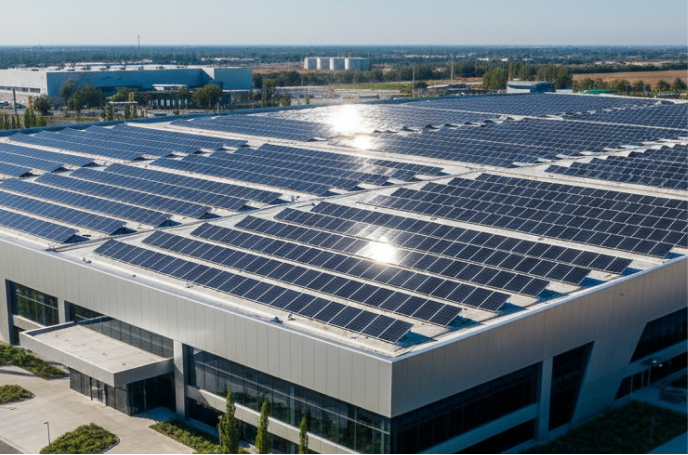
Can building owners co-invest, share revenue, or buy the solar system later?

Can building owners buy the solar system later or have a developer build the project for a fee?
If you're a commercial real estate owner exploring rooftop leasing or solar partnerships, you're probably wondering about your financial options beyond a simple lease arrangement. Can a developer build a community solar project for you on a fee basis ? CWhat if you want to buy the system down the road?
The short answer: Yes, both alternatives to a standard lease are possible—and the right choice depends on your investment strategy, tax position, and portfolio goals.
Let's break down each option so you can have an informed conversation with your Lumen Energy solar advisor about what makes sense for your properties.
Understanding the standard model first
In a typical rooftop leasing arrangement, a solar developer installs and owns the solar system on your property. You receive:
- Predictable lease payments for the use of your rooftop space
- Zero CapEx investment from your side
- White-glove service throughout the process
- ESG reporting benefits without operational complexity
This model is popular because it's straightforward: turn underutilized rooftops into predictable revenue streams without adding headcount or expertise to your team.
But it's not the only model. Let's explore the alternatives.
Option 1: Co-investment structures
What it is: You invest capital into the project, with sole ownership, and pay a developer a fee to secure the project's participation in a community solar program.
Why consider it:
- Capital deployment opportunity: By putting capital in, you capture more of the project economics—not just lease revenue, but also tax benefits, depreciation, and energy revenue.
- Strategic alignment: Self-ownership can give you more control over project decisions.
- Fund strategy alignment: If you're managing an infrastructure or sustainability-focused fund, direct solar investment may fit your thesis.
What to know:
- You'll need to evaluate your tax position—solar projects generate significant tax credits (ITC) and depreciation benefits that are most valuable to entities with tax liability.
- Self-ownership requires more due diligence and active management than a simple lease. You're now a project owner, not just a landlord.
- Investment-grade financial analysis becomes even more critical. You need property-specific financial models that account for your cost of capital, tax situation, and return hurdles.
When it makes sense: Self-ownership with the project developed on a fee basis by a 3rd party solar developer works well for owners with:
- Available capital allocated to alternative investments
- Tax appetite to absorb credits and depreciation
- In-house or advisory support to manage energy assets
- A strategic commitment to owning clean energy infrastructure
Option 2: Purchase options and termination rights
What it is: You negotiate the right to buy the solar system at a predetermined time (often year 5, 7, or 10) or at a fair market value when the developer decides to sell.
Why consider it:
- Optionality: You get the benefits of zero CapEx upfront, then decide later whether ownership makes sense as your strategy evolves.
- Asset control: Purchasing the system gives you full control over operations, revenue, and the ability to repower or upgrade equipment.
- Long-term NOI boost: Owning the system outright (post-purchase) can increase NOI with no ongoing developer payments.
What to know:
- Purchase options are typically structured with a strike price (fixed amount) or fair market value calculation. Make sure the methodology is clear upfront.
- Timing matters: Solar systems depreciate in value but may require reinvestment (inverter replacements, module upgrades). Understand the asset condition at purchase.
- Tax implications shift when you buy—you may be able to claim remaining depreciation or credits, depending on the structure and timing.
When it makes sense: Purchase rights work well for owners who:
- Want flexibility as their capital allocation strategy evolves
- Anticipate their tax position or fund strategy changing in 5-10 years
- Value long-term control over energy assets on their properties
- Are building out an owned renewable energy portfolio over time
How to decide what's right for your portfolio
The beauty of working with Lumen Energy as your modern solar broker is that we sit on your side of the table throughout this decision.
Here's how we help:
- Portfolio intelligence: Our proprietary Lux Engine delivers investment-grade financial analysis for every structure—lease, co-investment, revenue share, or hybrid. You'll see the returns modeled clearly across your properties.
- Competitive bidding: We put your preferred structure(s) out to our competitive developer marketplace. Developers submit bids, and we help you compare terms transparently.
- Strategic guidance: Your Lumen advisor will walk you through the trade-offs based on your fund strategy, tax position, and operational bandwidth. We're not pushing product—we're helping you make the right call.
- Flexible deal structures: Most developers are open to creative structures, especially for high-quality portfolios. We negotiate the terms that work for you, whether that's a lease today with a purchase option tomorrow, or a revenue share with a floor and ceiling.
Common questions we hear
Can I mix structures across my portfolio?
Absolutely. Your Lumen advisor can help you segment your portfolio based on property characteristics, market dynamics, and strategic priorities.
What if I'm not sure which structure is best?
That's exactly why Lumen Energy exists. We model multiple scenarios, pressure-test assumptions, and help you see the implications clearly. Then we go to market and let developers compete on your terms. You make the final call with full transparency.
Can I start with a lease and convert to ownership later?
Yes, if you negotiate a purchase option upfront . The key is to include this language in the original agreement. Your Lumen advisor will ensure these terms are locked in during the bid process if they're important to you.
The bottom line
Building owners have more flexibility in solar deal structures than most realize.
The key is working with a partner who represents your interests, not a developer's. As the modern solar broker, Lumen Energy ensures you see all the options, understand the trade-offs, and make decisions backed by rigorous analysis.
Ready to explore what structure makes sense for your portfolio?
Contact a Lumen Energy solar advisor today to get started with a portfolio analysis.
Related resources
- How Solar Generates Predictable Cash Flows for Commercial Real Estate
- Understanding Tax Benefits: ITC, Depreciation, and Your Solar Investment
- Rooftop Leasing vs. Co-Investment: A Financial Comparison
- What to Expect During the Lumen Bid Process
About Lumen Energy
Lumen Energy is the modern solar broker, partnering with leading real estate owners to turn their rooftops into new revenue. We deliver rigorous portfolio analysis, create transparent competition among top developers, and provide white-glove service throughout. Our efficient, technology-backed approach gives owners clarity, confidence, and reliable returns—scaling clean energy without added complexity.